
Reading time: 7 minutes

Preparing an initial guest list is the fourth step outlined in the article: " 10 steps to start planning your wedding ." With the right strategies in place, it can become an exciting part of your preparations.
This is a task that may seem simple at first glance, but can quickly become complex when considering the various relationships, social expectations, and budgetary constraints.
How can you select the guests who will brighten up this special day and avoid the complications often associated with this delicate process?
Together, we will take a detailed look at some of the most important aspects to consider so that you can create a guest list that reflects your true desires.
SUMMARY:
- The importance of drawing up a guest list from the outset
- Set rules and stick to them
- Create several individual lists before merging them
- Categorizing guests for effective planning
- Managing children's presence at the wedding
- A few rules and tips for perfecting your guest list and sorting through it
- Organize guest attendance during the peak period of the wedding
- Prepare alternative events
- Create your guest list with a spreadsheet
- Sending invitations
The importance of drawing up a guest list from the outset
One of the first points to consider when drawing up the guest list is why it is necessary to do so very early on in the wedding planning process.
Although the final list may change over time, having a rough idea of the number of guests from the outset is crucial for several reasons.
- First, many reception venues impose limited capacities in terms of guest numbers, which may restrict or influence your choice of wedding location. Some venues may require a minimum number of guests, while others may have a strict maximum capacity for safety and comfort reasons. Therefore, having a preliminary guest list will help you target reception venue options that best meet your capacity needs.
- Secondly, the number of guests will have a direct impact on the overall wedding budget. Each person added to the guest list will have an impact on expenses related to food, drinks, decorations, and furniture.
- Thirdly, drawing up a guest list from the outset will enable you to better assess the overall atmosphere of your wedding.
Therefore, by drawing up a preliminary guest list, you will be able to get a more accurate idea of the financial scope of your event.
This will enable you to plan better and allocate your budget more wisely, taking into account the potential costs associated with each additional guest.
Set rules and stick to them
It is crucial to establish clear and fair rules when compiling the guest list in order to avoid any confusion or imbalance.
The concept offairness does not necessarily require that each partner invite the same number of people, but rather that no one feels disadvantaged.
Therefore, if one spouse has the opportunity to invite certain members of their family or circle of friends, it is logical that the other spouse should be able to do the same.
Create several individual lists before merging them
The key to avoiding potential conflicts is to draw up separate lists of potential guests with your partner. Include everyone you want to invite on your side.
Once you have completed your individual lists, merge them and eliminate any duplicates. This will help you get a clear overview and avoid any important oversights.
It is crucial to show patience and mutual understanding during this delicate process, especially with regard to distant family members and close friends.
Categorizing guests for effective planning
Faced with a potentially overwhelming initial guest list, it is wise to divide guests into distinct categories.
This approach makes it easier to manage priorities and allows you to make informed decisions about who to invite to each wedding-related event.
Here are some basic categories you can use to classify your guests:
- Group 1: Very close people: parents, best friends, grandparents, brothers, sisters, and their spouses...
- Group 2: Close relatives: other friends, buddies, uncles, aunts, cousins, etc.
- Group 3: Less close circle of acquaintances: long-standing acquaintances, distant family, acquaintances, colleagues, etc.
By segmenting your guests in this way, you can better manage the guest list while ensuring that the people who are most important to you are present. Feel free to create your own groups.
Managing children's presence at the wedding
The presence of children at a wedding is often a sensitive issue for many couples.
For some, a child-free wedding is preferable to ensure a more formal and elegant atmosphere, while for others, including children adds a touch of spontaneity and warmth to the ceremony.
This decision may be influenced by various factors, including the type of celebration you are planning, the reception venue, and the availability of child-friendly facilities.
If you opt for an adults-only wedding, it is crucial to clearly communicate this preference to the families concerned, preferably individually and sensitively.
You can explain this decision by citing logistical considerations, budget constraints, or safety concerns, but it is essential to communicate this decision tactfully and be prepared for possible reactions from guests.
If children are invited, special activities appropriate for their age can be organized and a professional babysitter can be hired to supervise the children while the adults enjoy the celebration.
If you choose to limit the list to children in your immediate circle or of a certain age, be sure to clarify this decision with the parents concerned.
Open and transparent communication is essential to avoid any confusion or misunderstanding on the day of the celebration.
You can clearly specify in the invitations that only children of a certain age or children from the immediate family circle are invited, explaining the reason behind this decision.
A few rules and tips for perfecting your guest list and sorting through it
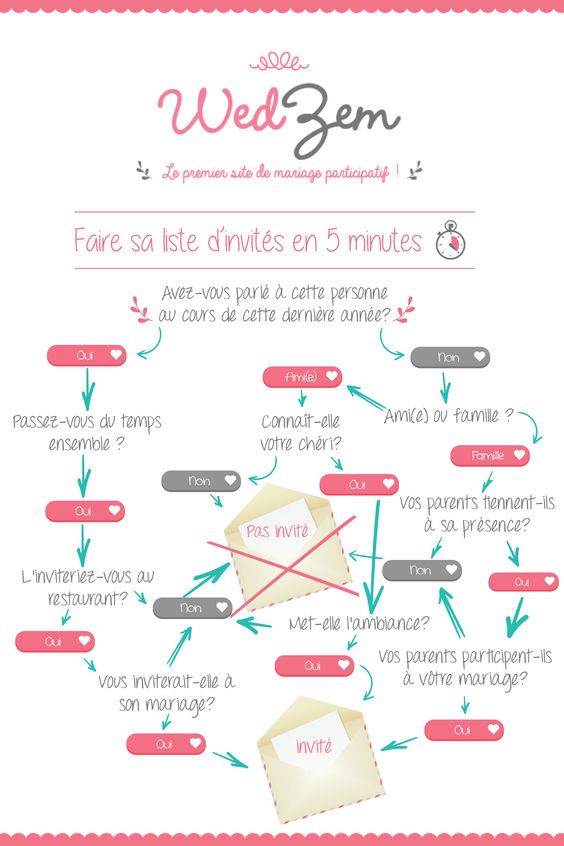
Creating a wedding guest list can be challenging, as the first draft often includes far more names than anticipated. Here are some tips to help you streamline the selection process. Consider the people in your wider circle and ask yourself these questions:
- Have you spoken to or seen this person in the past year?
- Do you particularly care about their presence on your wedding day?
- Do you consider this person to be a real support for your relationship?
- Have you had any significant interactions with these people recently?
- Do they share a close relationship with you and your partner?
- Would you consider inviting them individually to an expensive dinner?
When it comes to inviting your parents' friends, it is common for them to have acquaintances they would like to see at your wedding. While it may be acceptable in some situations to invite them, avoid doing so solely to please them.
Remember that your wedding is first and foremost yours, and the guest list should reflect your own choices and happiness.
· Some additional tips:
- Make decisions based on your personal connections with parents' friends, uncles, aunts, and cousins, not just on traditional expectations.
- Avoid inviting coworkers, unless you have developed friendships outside of the office.
- Consider reciprocity for those who invited you to their wedding or who may invite you in the future.
- It is not necessary to invite your friends' and family's plus ones, especially if you have never met them before.
- Don't forget to include yourself in the final list to avoid uncomfortable situations.
Here's a quick recap of Wedzem that I find very useful:
Organize guest attendance during the peak period of the wedding
When planning your wedding, it is essential to distribute your invitations wisely in order to better manage the capacity of the ceremony, cocktail reception, reception, and even brunch venues.
To this end, here are a few tips for optimizing the distribution of guests throughout your special day:
- Ceremony: Reserved for close family members and close friends, this part can be shared with those who matter most to you. Send them an invitation to this significant milestone.
- Reception: Expand your guest list to include acquaintances, colleagues, and other people with whom you have friendly relationships. These guests will receive a save-the-date card and a specific invitation to the reception.
- Reception: Limit the guest list to those who will play an active role throughout the celebration, including family members and close friends. These guests will receive an announcement card as well as invitation cards for the cocktail reception and reception.
- Brunch: To end the festivities on a high note, consider inviting your closest friends and family to a casual brunch. Choose those with whom you want to prolong this special moment and send them a separate invitation for brunch.
This approach will allow you to respect the capacities of the different venues while maintaining an intimate and warm atmosphere throughout the day.
Prepare alternative events
If you would like to invite loved ones who you cannot include in the main wedding ceremony, such as your neighbors, consider organizing more informal events such as a casual barbecue, a meal, or a simple get-together for drinks to mark the occasion.
These moments will give you the opportunity to celebrate your union with certain loved ones without cluttering up the main guest list.
Create your guest list with a spreadsheet
For greater efficiency, prepare a spreadsheet (Excel or other) to compile all the data on your guests.
Here are the columns to include as a priority:
- Name
- First name
- Adult, teenager, child, or baby
- Invited by (you, your spouse, your parents, your spouse's parents)
- Category (family, close friends, acquaintances, coworkers, etc.)
- Address
- Postal Code
- City
- Country
- Email address
- Phone
Then add the columns below to record your guests' attendance at different times during the wedding and fill in 0 or 1 depending on whether or not the guests are invited, so that you can calculate the totals:
- Civil ceremony
- Religious/secular ceremony
- Reception
- Reception
- Brunch
Then, once you are more advanced, you can add the columns below to keep track of invitations sent and responses received.
- Save the date
- Announcement
- Answer
- Response date
You can finish with important information or comments by adding the following columns if necessary:
- Menu selection (meat, fish, vegetarian, etc.)
- Allergies or special dietary requirements
Sending invitations
When sending invitations, certain rules must be observed, particularly with regard to how the recipient is addressed:
- If you wish to invite an entire family, it is advisable to write "Family..." followed by the name. This will allow the recipients to understand that the couple and their children are invited.
- If you are inviting a couple whom you know both of, but who are not married, it is recommended that you write both names on the envelope and on the invitation.
- If you are inviting someone and are not familiar with their spouse, you can simply write the name of your main guest and add "+1" next to it.
In conclusion, drawing up your guest list is an important task to complete before embarking on any other wedding preparations, as it can have an impact on many factors, such as finding a reception venue and setting your budget.
If you need help getting started with planning your wedding, please don't hesitate to contact us. Together, we will turn your vision into a magical and memorable reality.
XOXO,
Vanessa